Welcome. You are going to collaborate and create a discussion over biochemistry and nuclear chemistry, with the help of your classmates. Over the next few weeks you are going to use this blog to answer questions such as:
What is it? Who uses it? Why is it important?
You are also going to learn about current research and developments in the field. Find exciting examples of basic and applied research, add images and video and be creative.
I will monitor your comments and redirect as needed.
Scientists have found new clues which could help them harness the power of photosynthesis. They have discovered an enzyme used in photosynthesis. This enzyme gives scientists the ability to extend light harvesting in plants into the far-red range of the light spectrum (Figure 1) This allows the plants to more efficiently use the energy from the Sun and could increase plant productivity. This discovery could allow scientists being able to engineer crops to make them better using these qualities. As Donald A. Bryant, the Ernest C. Pollard Professor of Biotechnology and professor of biochemistry and molecular biology at Penn State University stated, “Knowledge of how photosynthesis evolved could empower scientists to design better ways to use light energy for the benefit of mankind.” This enzyme enables plants to give off oxygen more efficiently due to the ability to reach light at different wavelengths. If harnessed, this could also be used as an alternate energy source that is not harmful to the environment.
Figure 1
What the Scientists did:
Scientists first identified the gene that converts chlorophyll a (the most abundant light-absorbing pigment that harness energy through photosynthesis) into chlorophyll f (Chlorophyll that absorbs light in the far-red range of the light spectrum) (as seen in Figure 2). There are several different types of chlorophyll, each tuned to absorb light in different wavelengths. Chlorophyll f is found in certain cyanobacteria (bacteria that use photosynthesis) that grow efficiently in light just outside of the usual human visual range. The ability to use light wavelengths other than those absorbed by plants, algae, and other cyanobacteria gives a powerful advantage to those organisms that produce chlorophyll f. These organisms can survive and grow when the visible light they normally use is blocked. Then scientists discovered the enzyme in the gene that allows for the conversion of chlorophyll a to chlorophyll f. This enzyme could represent an early stage in the evolution of photosynthesis. This enzyme is unique in that it requires light to catalyze its reaction and may not require oxygen.
Figure 2
How this relates:
This discovery is basic research because scientists are just starting to discover the enzyme that allows for photosynthesis to occur in places where light is less visible. Scientists have not implemented it into use. Scientists not only identified the gene that converts chlorophyll a to chlorophyll f, but identified the specific enzyme. This is the beginning of new advances in photosynthesis. In addition this discovery relates to green chemistry in that if harnessed, this could be an alternate energy source coming from plants as well as engineer crops to be more efficient. As stated by researchers Sekar and Ramasamyr, "Photosynthesis has potential for renewable energy generation in a sustainable and environment friendly manner. "
Botulinum Toxin: Why It Is So Deadly and Why People Are Using It
All throughout history, there has been a need to improve our appearance and our health. With new discoveries as well as advancements in technology, there are now more options for cosmetic and medical procedures. Botulinum toxin, more commonly known by the commercial name “Botox” or “Dysport,” is one of the most deadly toxins on earth, yet it commonly used for beauty purposes and is even used to treat certain health problems.
The History of Botulinum Toxin
The botulism bacterium, clostridium botulinum, was discovered by Emile Pierre van Ermengem after there was an outbreak of botulism from smoked ham in a Belgian village. In the early twentieth century, the toxin released by the clostridium botulinum bacteria was isolated. The various strains of botulinum toxin are large peptides, which are chains of amino acids that are held together by a disulfide bridge. One amino acid chain has a molecular weight of 100 kDaltons, and the second chain has a molecular weight of 50k Daltons.
How Botulinum Toxin Works
The heavier amino acid chain is used to detect and bind to nerve fibers and absorb into the cell. In the lighter amino acid chain, an enzyme called protease breaks up the proteins that release neurotransmitters. One of these neurotransmitters is acetylcholine which is a chemical messenger that tells muscles to contract and is located where nerve endings meet the cells. When the acetylcholine is broken down and prevented from releasing, this leads to flaccid paralysis, which means the muscle is unable to contract. The reason for most botulism related deaths is due to the fact that the botulinum toxin reaches the respiratory system and causes respiratory failure. An estimated that one gram of botulinum toxin could kill as many as one million people and several kilos of the toxin could kill every human on earth.
Uses for Botulinum Toxin
Despite the numerous dangers associated with botulinum toxin, a very small concentration of the toxin can be injected into humans to paralyze muscles. Botulinum toxin is administered by plastic surgeons to address cosmetic concerns such as:
Glabellar lines (frown lines between the eyebrows)
Canthal lines (crow's feet)
Forehead furrows
Skin bands on the neck
Botulinum toxin is also administered by doctors to treat:
Blepharospasm (spasm of the eyelids)
Idiopathic rotational cervical dystonia (severe neck and shoulder muscle spasms)
Chronic migraine
Severe primary axillary hyperhidrosis (excessive sweating)
Strabismus (crossed eyes)
Post-stroke upper limb spasticity
Detrusor overactivity urinary incontinence
Overactive bladder
Hemifacial spasm
The different types of botulinum toxin have been categorized into type, A, B, C, D, E, F. Fairly recently however, a new type of botulinum toxin, type H, has been discovered and is now known as one of the most deadly neurotoxins on the planet.
Sandia National
Laboratories: The United States’ Leap into the World of Nuclear
Weaponry, and the Safety and Security Thereof.
Sandia National Laboratories
ca. 1950
Sandia National Laboratories
was established in 1945 as the “Z Division” of Los Alamos National Labs. Soon,
growth of the US’ nuclear arms design, assemble, and testing programs forced
Sandia to part ways with Los Alamos. Sandia, still the “Z Division” at this
point, moved to Sandia Base near Albuquerque, giving them access to an airfield
and all the personnel and infrastructure an Air Force Base can provide. Soon, in
November, 1949, Sandia Corporation (Owned by Western Electric) began managing
Sandia. In 1956, Sandia expanded, opening a lab in Livermore, California. By
1979, Sandia was given full National Laboratory status, and was transferred to Lockheed
Martin in 1993. Finally, on May 1, 2017, the lab was transferred to National
Technology and Engineering Solutions of Sandia, LLC, a subsidiary of Honeywell
International, Inc.
Sandia Laboratories
has accomplished numerous feats pertaining to the design, testing, and security
of the United States’ nuclear arsenal. Sandia’s research led to the increased
safety, mobility, and sustainability/readiness of the US's nuclear armaments. Sandia, previously known as the "Z Division," was a close counterpart of Los Alamos National Laboratory, the birthplace and home of the Manhattan Project, the US's nuclear weapon development program. Sandia's main role in the Manhattan project was to ensure the safety and security of the nuclear weapons designed by the scientists at Los Alamos. Sandia National Laboratories' greatest feats have been the creation of the Permissive Action Link, Safe Secure Trailer, and the Weigh and Leak-Check system (in collaboration with Pantex).
A Brief Tour of Sandia National Laboratories
(c) Sandia National Laboratories
Permissive Action Link
The Permissive Action Link system, or a PAL for short, is a device used to protect and prevent the unintentional deployment of nuclear weaponry. The PAL system ensures that a nuclear device can only be deployed if approved by the president. Early PALs were simply padlocks, whereas modern PALs contain advanced computers, overrides, and cybersecurity measures. The early day PAL required two, three digit combinations, with one being from an officer, so that the missiles containing warheads could not be fired unless instructed to do so by the national executive and commander in chief. Modern PALs consist of a computerised launch system, requiring longer codes, and having the capability to "lock down" after too many incorrect codes. However, many of these early, and even semi-modern PAL systems were easily dismantled or bypasses, thus proving to be an ineffective method for protecting America's most deadly weapons. When the Joint Committee on Atomic Energy asked for a solution, Sandia NAtional Laboratories, in collaboration with Los Alamos NL, devised a solution. The labs created a solution involving a "mechanical or electromechanical code switch in the warhead in a location such that it could not be bypassed easily. To foil any attempt to bypass the device, the switch's appearance and markings were disguised to make its function unclear unless the weapon's manual were also available," (Columbia.edu). After the creation of this system, armaments were designed with a PAL device embedded to the electric circuitry of said weapon. The PAL system serves as both a safety and security system for the United States' nuclear armoury and was made possible through the hard work of Sandia National Laboratories.
Modern Day Recreation of an early PAL. (No original photos are available due to confidentiality of such 'advanced systems' )
The Safe Secure Trailer System
A Safe Secure Trailer system (SST) is used to transport dangerous cargo, AKA nuclear armaments, from location to location. This system was designed and developed by Sandia National Laboratories in 1970. The trailer is completely bulletproof, and the driver doesn't have the ability to open the trailer. Each trailer is driven by a federal agent, and escorted by a group of armed vehicles. These transporters are conspicuous, and the naked eye of an uneducated citizen would have a difficult time discerning a difference in the SST and a regular tractor trailer. These systems have evolved over the years, and are now simply described as "mobile vaults" by the US Department of Energy, the user of said systems. "The Albuquerque Operations Office, [Sandia National Laboratories] established the Transportation Safeguards Division in 1975." In Fiscal Year 1997, TSD employed 237 nuclear material couriers who act as Special Agents in transporting nuclear weapons, components, and material for the Department of Energy. These specially trained "couriers" are able to defeat any situation that comes their way, and have an impecable track record given the brilliant design of the SST by Sandia National Laboratories. The US' nuclear defense system would prove ineffective if weapons couldn't be mobilized because all weapons would be stuck in one place, where they are unusable and impractical.
Map of the Operation Locations of Secure Trailer Systems throughout the United States of America
Weigh and Leak Check System
The Weigh and Leak Check system (WALS), created as a collaboration between Sandia and Pantex, stores radioactive materials, known as pits. This system stores and moves nuclear "cores"(known as pits) at the Pantex weapons assembly plant in Amarillo, Texas. According to Sandia, " WALS uses a 6-axis robotic arm on a 25 ft. linear track. The robotic arm is programmed to move pits to custom tooling and automation stations, where the pits are unpacked from their containers, removed from their shipping fixtures, weighed, leak-checked, and repacked. WALS also has a suite of sensors and safety features necessary to operate the robot safely and reliably." This system greatly reduces the amount of radiation, specifically gamma emittance, that workers who are required to handle the nuclear pits/cores are submitted to on a daily basis, and can prevent diseases such as cancer that are caused by said radiation exposure for the workers. The scientists at Sandia even took into account the methods of which they want the WALS to fail, should the situation ever arise. This is to prevent catastrophic disasters from happening, and to ensure the safety of those responsible for handling the disassembly and assembly of nuclear weaponry. In the future, a WALS system will most definitely be deployed to all areas where nuclears pits/cores are handled, and will increase the overall safety of the United States' nuclear materials handling capabilities.
Carbon Dating and the Dangers that Outside Forces May Pose
Due to processes contributed by the scientific community, such as carbon dating, the rest of society can contribute to humanity’s understanding of our world and its most complex inner workings, including tracing back an object’s date to millions of years.
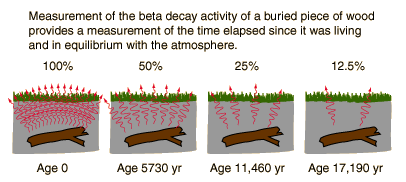
Carbon dating is a radioactive dating process which can only be used on once living objects who were once at equilibrium with the atmosphere in taking in carbon dioxide. Primarily, this can refer to plants which undergo photosynthesis, in taking in carbon dioxide and releasing oxygen. However, this can also refer to animals who ingest the plants, as they are also ingesting the element used in carbon dating: carbon-14. On Earth, there are cosmic ray protons which originate from somewhere in space. These protons shoot their nuclei in the atmosphere, which in turn produces neutrons to bombard the nitrogen in the atmosphere. From this transmutation reaction, carbon-14 is created, where it can combine with oxygen to form carbon dioxide. Therefore, this carbon-14 is continually being absorbed by the plants on Earth and then ingested by all animals, whether they consume the plants directly or whether they eat other animals who are herbivores. Since the carbon-14 is constantly being created by the bombardment of nitrogen, scientists can measure the amount of substance in the atmosphere versus the amount that has been emitted from a once-living object. Once a living thing dies, they begin to emit carbon-14. According to hyperphysics.phy-astr.gsu.edu, “Carbon-14 decays with a halflife of about 5730 years by the emission of an electron of energy 0.016 MeV. This changes the atomic number of the nucleus to 7, producing a nucleus of nitrogen-14. At equilibrium with the atmosphere, a gram of carbon shows an activity of about 15 decays per minute”
Figure 1
(See Figure 1). From an understanding of carbon dating, scientists have used the process to date back objects such as trees, animals, and even humans. However, this process may be in danger.
From a study conducted in 2015, research was found showing that emissions from fossil fuel may limit carbon dating. When pumping the fossil fuels, another type of carbon is released into the atmosphere. This new carbon combining with the carbon-14 may confuse the real ratios of the carbon-14 in the atmosphere, which creates a diluted effect. Dr. Graven explains, "If we did any current measurements on new products, they will end up having the same fraction of radiocarbon to total carbon as something that's lost it over time due to decay," said Dr Graven. For example, in 2050, if this process continues to occur, a shirt would appear to be the same age as a piece of clothing wore by William the Conqueror. The exact severity of this problem will depend on how much the emissions will increase over the next couple of years. For instance, if the emissions continue to grow at the rate they are, they could reach an age of 1000 years by 2050 or 2000 years by 2100.
Avocados are one of the healthiest foods out there. They contain many nutrients lacking in the average american diet. Some of these healthy nutrients are pantothenic acid, dietary fiber, vitamin K, copper, folate, vitamin B6, potassium, vitamin E, and vitamin C. They are also a good source of nutritious fats. An avocado holds between 71% and 88% of its calories in its fat. It’s quite obvious that would be able prevent many diseases.
A recent study conducted by Cancer Research demonstrated that one of the fats found in avocados, avocatin B, can be used to fight against cancer. This particularly deadly form of cancer is known as acute myeloid leukemia and is also referred to as AML. According to The U.S National Library of Medicine, acute myeloid leukemia is the most common form of leukemia in adults. Out of an estimated 62,130 new cases of leukemia in 2017, about 21,380 will suffer from AML to which will result in 10,590 deaths. For those over 65 who suffer from AML, 90% of patients will die within 5 years.
The basic research found that the specific avocatin B selectively targets the the leukemia stem cell. This means that it will not harm the healthy bodily cells, preventing the harm done by chemotherapy (radiation therapy). Professor Paul Spagnuolo from the University of Waterloo elaborates further in his interview with Davidwolfe.com “The stem cell is largely responsible for the disease developing and it’s the reason why so many patients with leukemia relapse. [...] We’ve performed many rounds of testing to determine how this new drug works at a molecular level and confirmed that it targets stem cells selectively, leaving healthy cells unharmed.” It was reported that it performs even better than man made drugs. Preparation for phase one of clinical trials has already begun for the applied research side of things. Avocados also contain a cancer fighting carotenoid. They act as antioxidants that protect cells from free radicals found in those with lung cancer from the chemicals in the smoke they inhale. These free radicals can damage cell membranes and DNA of the human body. Avocados contain 11 different kinds of carotenoids. In California, they were able to locate exactly where the carotenoid was and published guidelines for getting the most out of your avocado. To get the full effect you need to eat the avocado seed. 70% of the antioxidants are located in the seed of the avocado. To ingest the nutrients, you can either grate the avocado seed or turn them into powder by roasting them and passing them through a food processor.
This will provide more surface area for the acids in stomach to dissolve as well as allowing you to eat it without choking yourself. They are also anti-inflammatory and contain many soluble fibers which can prevent gastric ulcers, constipation, and diarrhea. In addition their amino acids and dietary fibers, the innards of the avocado can reduce cholesterol and cardiovascular issues. Lastly the antioxidants discussed earlier have been known to rebuild collagens and repair cell damage which reduces the signs of aging.